
Introduction
ANSI Z87.1 is the most widely recognized standard for evaluating the impact resistance and safety performance of eye and face protection products. Manufacturers, quality control engineers, and testing laboratories rely on ANSI Z87.1 to verify that safety glasses, goggles, and face shields can withstand defined mechanical hazards. At the center of this standard lies a series of impact tests designed to simulate real-world risks, among which the ball dropping test plays a crucial role.
The ball dropping test described in ANSI Z87.1 serves as a foundational method to confirm that protectors possess a minimum level of impact resistance. This ball impact test standard uses gravity-driven energy rather than high-speed projectiles, making it highly repeatable and suitable for routine quality checks with a calibrated impact testing machine.
Why ANSI Z87.1 Matters in Impact Safety Evaluation
ANSI Z87.1 establishes minimum performance requirements for protectors intended to shield the eyes and face from impact, penetration, and related hazards. Unlike general mechanical testing, ANSI Z87.1 connects test results directly to user safety. Products that pass the required impact tests demonstrate that they can resist sudden forces without cracking, shattering, or dislodging.
For manufacturers and buyers alike, compliance with ANSI Z87.1 offers three critical benefits:
- Objective verification of impact resistance
- Consistency across production batches
- Market and regulatory acceptance
Among the different evaluations defined in the standard, drop-based impact testing provides a straightforward and repeatable way to assess basic mechanical strength.
Purpose of the Ball Dropping Test
The primary purpose of the test is simple but essential:
to ensure that lenses and protective devices can withstand a defined impact without failure.
During the test, a steel ball strikes the lens area aligned with the eye position. The test does not aim to analyze energy absorption behavior in detail. Instead, it focuses on pass/fail performance—whether the protector cracks, fractures, or allows contact with the eye region.
Apparatus and Test Setup
ANSI Z87.1 specifies clear requirements for the testing apparatus to ensure consistency:
- A rigid headform mounted horizontally on a heavy base
- A bola baja with a diameter of 25.4 mm and a mass of 68 g
- A guide tube that ensures vertical drop alignment
- A controlled drop height of 127 cm
The headform stiffness and mounting mass reduce unintended movement during impact, ensuring that test results reflect the protector’s performance rather than fixture instability. Meter or square specimens of 100 × 100 mm are commonly used.
Application Materials Commonly Tested Under ANSI Z87.1
ANSI Z87.1 applies to a wide range of materials and product constructions. Typical application materials include:
- Polycarbonate lenses used in industrial safety glasses
- Acrylic and composite lenses with surface coatings
- Face shield windows for industrial and medical environments
- Protective goggles used in laboratories and manufacturing
Each material behaves differently under impact. The standardized ball dropping test allows manufacturers to compare designs objectively while maintaining compliance.
Role of Impact Testing Machines in Compliance
Reliable compliance depends on precise and stable equipment. A well-designed impact testing machine ensures accurate drop height, repeatable alignment, and consistent test conditions. Modern systems also improve efficiency by simplifying specimen mounting and result recording.
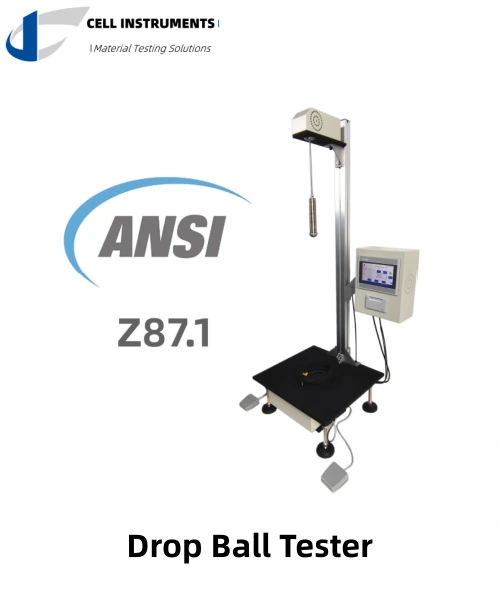
For laboratories and manufacturers conducting ANSI Z87.1 testing, instruments such as the Cell Instruments Drop Ball Tester provide a practical solution. Its controlled release mechanism, rigid structure, and user-friendly operation help testers perform ball dropping tests with confidence while meeting standard requirements.
Supporting Quality Control and Market Confidence
ANSI Z87.1 testing does more than satisfy a specification. It supports quality assurance, product development, and customer trust. By integrating standardized ball impact testing into routine inspection, manufacturers can detect material or process variations early and maintain consistent performance across production lots.
Cell Instruments Co., Ltd. supports this goal by offering impact testing solutions tailored to safety, packaging, and industrial material applications, helping users achieve reliable and traceable test results.
Conclusion
ANSI Z87.1 provides a clear and authoritative framework for evaluating impact resistance in eye and face protection. The ball dropping test, supported by a reliable impact testing machine, remains a cornerstone of this standard. By understanding the test purpose, procedure, and applicable materials, professionals can ensure compliance, enhance safety performance, and strengthen product credibility in demanding markets.
 ID
ID  EN
EN  ES
ES  DE
DE  FR
FR  IT
IT  AR
AR  KO
KO  JA
JA  RU
RU  PT
PT  BG
BG  CS
CS  DA
DA  EL
EL  ET
ET  FI
FI  HU
HU  LT
LT  LV
LV  NL
NL  PL
PL  RO
RO  SK
SK  SV
SV  SL
SL  UK
UK  TR
TR  NB
NB