
Introduction
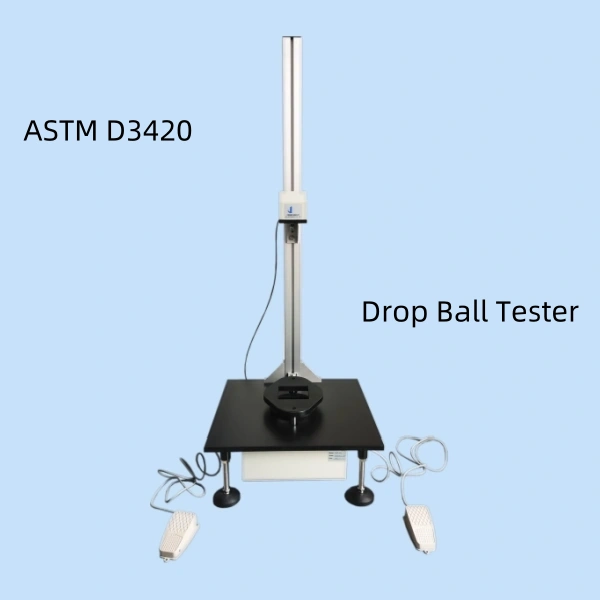
The Drop Ball Tester is an essential instrument for evaluating the impact resistance of plastic films and sheets, offering a reliable method to determine material toughness. It is widely used in packaging, medical, and industrial applications, where film durability is critical. This tester helps professionals comply with plastic impact test ASTM D3420, ensuring materials meet the required performance standards under dynamic stress.
The plastic impact test ASTM D3420 specifies the method for measuring the puncture resistance of plastic films using a pendulum or drop ball system. Unlike low-speed tensile tests, this method provides insight into the material’s behavior under high strain rates, which closely mimics real-world conditions. This standard is crucial for packaging films, medical wraps, and other protective sheets where sudden mechanical stress may occur.
Key Significance:
Measures toughness and energy absorption during impact.
Helps in assessing suitability for end-use applications.
Supports quality control and product development in packaging and film industries.
Principle of Drop Ball Testing
In a Drop Ball Tester, a rounded steel or hardened ball is dropped from a predefined height onto the specimen placed on a support fixture. The energy required to puncture or burst the film is measured and recorded. The test evaluates the mechanical performance of films under dynamic impact conditions.
- The specimen is clamped securely to prevent slippage, as slippage can significantly affect results.
- Energy readings are calculated using either direct measurement or pendulum conversion formulas depending on the tester type.
- For ASTM D3420, both Procedure A (60 mm aperture) and Procedure B (89 mm aperture) are applicable, accommodating different sample sizes.
Test Specimen Requirements
For accurate results, specimens must be:
- Uniform in thickness and free of defects.
- Flat and representative of the batch being tested.
- Conditioned according to ASTM D618 for consistent humidity and temperature.
Typically, at least five specimens are tested per batch to ensure reliability. Circular specimens of 100 mm diameter or square specimens of 100 × 100 mm are commonly used.
Apparatus and Setup
The Drop Ball Tester consists of:
- A heavy base and housing to stabilize the instrument.
- A free-falling or pendulum-guided ball with defined dimensions.
- Clamping plates to hold the specimen in place.
- A calibrated dial or digital readout to record energy to rupture.
Preparation Tips:
- Level the tester on a flat surface.
- Verify pendulum or drop ball alignment.
- Zero the readout according to manufacturer instructions.
- Ensure clamps are secure to minimize specimen movement during impact.
Testing Procedure
- Measure specimen thickness accurately with a micrometer.
- Place the specimen in the holder and secure it.
- Release the ball or pendulum to impact the specimen.
- Record energy or scale readings for each test.
- Observe for any slippage or misalignment; repeat if necessary.
- Calculate impact energy using ASTM D3420 formulas.
This method ensures that impact resistance is measured consistently and is representative of the material’s real-world performance.
Advantages of Using Cell Instruments Drop Ball Tester
The Cell Instruments Drop Ball Tester provides:
- High precision measurement for both Procedure A and B.
- Stable, repeatable results for quality control and research.
- Easy operation with secure specimen clamping to minimize error.
- Digital and analog readouts for versatile applications.
- Compliance with ASTM D3420, ensuring test credibility for regulatory and industrial requirements.
Rakendused
Pakenditööstus: Testing films for food, medical, and industrial packaging.
Medical Devices: Evaluating protective wraps and barrier films.
Research & Development: Material toughness assessment during product development.
Quality Control: Batch testing to confirm consistency and performance.
Conclusion
A Drop Ball Tester is a crucial tool for determining the impact resistance of plastic films and sheets. By following plastic impact test ASTM D3420, engineers and quality control professionals can ensure materials meet the required standards for toughness, durability, and end-use performance. Using reliable instruments like Cell Instruments Drop Ball Tester enhances accuracy, efficiency, and compliance with industry standards.
 ET
ET  EN
EN  ES
ES  DE
DE  FR
FR  IT
IT  AR
AR  KO
KO  JA
JA  RU
RU  PT
PT  ID
ID  BG
BG  CS
CS  DA
DA  EL
EL  FI
FI  HU
HU  LT
LT  LV
LV  NL
NL  PL
PL  RO
RO  SK
SK  SV
SV  SL
SL  UK
UK  TR
TR  NB
NB