
Protective films are widely used to safeguard surfaces during manufacturing, transportation, and storage. Ensuring these films can withstand mechanical stress is critical to maintaining product quality. One of the most effective ways to evaluate film durability is the ball dropping test, a method that quantifies a film’s resistance to impact and puncture. Conducted according to ASTM D3420, this test provides reliable data for both quality control and research applications.
Understanding the Ball Dropping Test: ASTM D3420
Το ball dropping test is designed to determine the amount of energy a film can absorb before failure. In this method, a ball of known weight is dropped from a specified height onto the protective film mounted on a fixture. The test measures how much energy is required to cause penetration or rupture, simulating real-world impacts that packaging films or protective coatings might encounter.
ASTM D3420 provides standardized procedures for performing this test, ensuring reproducibility and comparability of results across laboratories. By following these guidelines, manufacturers can assess the toughness of films accurately, helping in material selection and process optimization.
Key Benefits of the Ball Dropping Test
- Provides a quantitative measure of film toughness under dynamic conditions.
- Simulates practical impacts to evaluate protective performance.
- Helps identify weak batches and ensures consistency in manufacturing.
- Supports research and development in improving film formulations and coatings.
Procedure for the Ball Dropping Test
The test is performed using a calibrated impact testing machine equipped with a controlled drop mechanism. Key steps include:
- Specimen Preparation: Cut the film to a size compatible with the fixture. Ensure the surface is smooth and free from defects to avoid inaccurate readings.
- Mounting: Secure the film over a rigid support or aperture to mimic real-life applications, ensuring uniform tension.
- Impact Application: Drop the ball from a predetermined height. Record the energy or height at which the film is penetrated. Some setups allow incremental adjustments to identify the threshold energy.
- Data Recording: Note the occurrence of puncture or tear and calculate the energy absorbed using machine readings.
- Analysis: Compare results with material specifications or historical data to evaluate film performance.
By conducting multiple replicates, quality control teams can account for natural variability and produce statistically significant results.
Significance of the Ball Dropping Test for Protective Films
Το ball dropping test is essential for assessing the mechanical reliability of protective films, which may be used in electronics, automotive components, or fragile surfaces. Key applications include:
- Quality control: Detecting production inconsistencies in films before they are shipped.
- Product development: Comparing new film formulations for toughness and durability.
- Packaging optimization: Ensuring films used in protective layers or laminates can withstand expected mechanical stresses.
Using standardized tests such as ASTM D3420 ensures that protective films meet industry requirements and maintain high performance across different applications.
Best Practices for Reliable Impact Testing
- Calibration: Regularly calibrate the impact testing machine to ensure accurate energy measurements.
- Specimen uniformity: Maintain consistent film thickness, size, and mounting conditions.
- Controlled environment: Perform tests under standardized temperature and humidity to minimize variability.
- Documentation: Record all test parameters, including ball weight, drop height, and material properties for traceability.
Recommended Equipment: Cell Instruments FBT-01 Drop Ball Tester
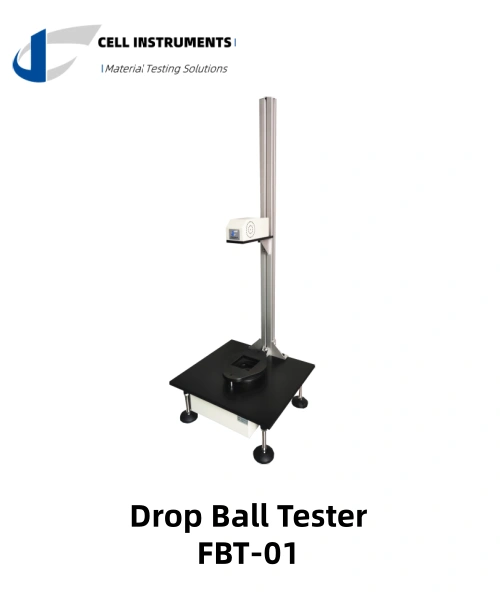
Το Όργανα κυττάρων FBT-01 Drop Ball Tester is an ideal solution for performing the ball dropping test on protective films. Features include:
- Adjustable drop height: Allows testing across a range of impact energies.
- Precision impact measurement: Provides accurate and reproducible data for quality control.
- User-friendly design: Simplifies specimen mounting and test execution.
By integrating the FBT-01, manufacturers can efficiently evaluate film toughness, ensuring protective films meet durability standards and customer expectations.
Conclusion
Το ball dropping test is a critical method for evaluating the mechanical resistance of protective films. Following ASTM D3420 procedures with a reliable impact testing machine, such as the Cell Instruments FBT-01 Drop Ball Tester, allows manufacturers to quantify energy absorption and ensure film durability. Implementing this test as part of quality control and product development ensures that protective films consistently perform as intended, safeguarding products throughout their lifecycle.
 EL
EL  EN
EN  ES
ES  DE
DE  FR
FR  IT
IT  AR
AR  KO
KO  JA
JA  RU
RU  PT
PT  ID
ID  BG
BG  CS
CS  DA
DA  ET
ET  FI
FI  HU
HU  LT
LT  LV
LV  NL
NL  PL
PL  RO
RO  SK
SK  SV
SV  SL
SL  UK
UK  TR
TR  NB
NB